Monday, July 4, 2016

The Hunt for Spontaneity and Trust at Boom Chicago

Boom Chicago is an English-language improvisational theater in Amsterdam, which stages a variety of unscripted shows on various topics and genres. Their regular 10:30pm Saturday night show, “Shot of Improv,” is a 75-minute short-form show, consisting of discrete games and scenes. Many of these games use some thematic or formal constraint as the means to create a scene: one is likely to see a scene inspired by a word suggested by an audience member, a scene in a chosen literary genre, or a scene entirely in rhyme. “Shot of Improv” was ostensibly built around this conceit, even going so far as to encourage audience participation with the offer free alcohol. Yet these and other conventions of improvisational theater were at points employed nominally in a way which actually seemed to prohibit engagement with genuine moments of spontaneity and connection. Furthermore, the show had a consistent pattern of invoking “taboo” content in scenes, including racial and gender stereotypes, homophobia, and disability. While it is not primo facie inappropriate to engage with or explore these topics on stage, the technical performance choices during the show made it very difficult to distinguish between offensive speech on the part of the character or the improvisor.

Every improv show operates at two narrative levels simultaneously. One story is about the characters onstage and the situations in which they find themselves. The other story is about the improvisors discovering those characters and stories in real time. Improvisation trades in this dual-storiedness: the experience of the show both as the onstage product—the games and scenes performed—and the shared discovery of what that product is. The audience and improvisors share in this discovery, which creates a relationship of trust between the two parties. This relationship is unique in every show, deepened by the shared knowledge that whatever happens onstage will be ephemeral.

Improvisation need not be comedic, but it has a reputation as comedy which informs audience expectations. Even theaters that specifically choose not to bill themselves as “Improv Comedy” attract audiences that anticipate a comedic show. This is not a necessary dimension of the form, but it is a quality of the current state of the craft which improvisors have the power to affirm or subvert as the story requires.

Managing the audience’s expectations is a part of the second meta-theatrical narrative of each improv show. If a show moves out of the realm of comedy and into more dramatic or serious thematic territory, the improvisors have the power to draw the audience alongside them, building on the energy and trust to explore new content and form. This is not the only way to engage with audiences, nor is it necessarily the “right” one. But ignoring the expectations of and relationship with the audience and failing to attend to it destroys the second narrative. This is particularly the case when material journeys into not only thematically dark, but potentially hurtful or offensive territory.

In scripted theater and performance, the audience understands and assumes that thought has been put into every word spoken. A long process of editing has preceded the product, and so the audience assumes intentionality behind each staging choice and line of dialogue. However, in improvised theater, the entire conceit is that no content has been prepared. This inability to edit or self-edit blurs the line between the story within the show and the story of the show’s creation, a blur that has the potential to become dangerous when the characters onstage are addressing sensitive topics such as race or disability. If no attempt is made to establish the scene and characters, then it becomes difficult to determine whether a hateful or ignorant line of dialogue is being spoken by the character or by the improvisor.
There are many sides and dimensions to the debate of what, if any, content is “off-limits” in art and in comedy. I don’t know that there is a clear, universal line. Whether something is “offensive” is a function of the material it deals with as well as the delivery, contextual world-building and characterization, and the audience relationship.

And, when there is no effort at all being taken to establish characters or scenes, then the first narrative disappears altogether. When characters are unnamed, locations are never established, and hands are obliviously waved through mimed “space object” props without justification, it is difficult for scenes to be created or worlds to be established onstage. When this happens, the first narrative dissipates and only the second one remains: the narrative in which a group of performers manipulate the procedure and rhetoric of improv to justify their own gratuitous engagement with offensive content.

Asking for audience volunteers and suggestions is a practice commonly used in improvisational theater around the world. This serves several purposes within a show. Using a suggestion as the basis of a scene reinforces to the audience that everything is being made up on the spot. It is a conventional offering meant to build a relationship of trust between audience and performers. Boom Chicago used the tool of audience engagement to show that they were performing live, but did so in a way which in fact further damaged their relationships with the audience. In one game, for instance, the improvisors asked for an audience member to volunteer his phone without explaining that their game would require his personal texts to be read aloud. This lack of transparency fostered a relationship in which the audience members felt uncomfortably put on the spot and disrespected by several of the players onstage.

At another point, an audience member was brought onstage for a game in which two teams of improvisors presented her with pick-up lines. Each two-person team was required to construct these lines one word at a time, with each member alternately adding a word. This is a common constraint used in improvisation, one that led one group to make incoherent, rambling declarations of love and the other to make short, lewd come-ons. When asked to judge between the two, she consistently chose the first team’s shabby run-on sentences because she did not like the overtly sexual content of the second team’s offerings. Over the course of the game, the first team realized that she disliked more explicit lines and tried to make her feel more comfortable even though it resulted in less pithy pick-up lines. Meanwhile, the second team responded to her and the audience’s uncomfortable laughter by doubling down. Although she giggled throughout, her firm but polite refusal to award points to them suggested serious discomfort with their behavior.

This inattention to audience experience and response made it hard for the audience to trust in the improvisors, inadvertently accomplishing the opposite of what that these participatory moments set out to do.

Audience input also aids the improvisors by acting as a constraint system. Suggestions have the potential to function as thematic constraints which inspire the content of scenes — say, a scene that starts from the word “ice,” “crayon,” or “turtle”— or can provide a formal constraint such as a genre in which a scene is performed or a letter which cannot be in any words spoken onstage. The joy in experiencing these scenes arises not only from the dramatic quality of the scene that is performed, but also from the experience of watching the improvisors negotiate that constraint.

One popular game, for instance, uses an audience volunteer’s cell phone as a constraint. The improvisors are tasked with performing a scene in which one character’s dialogue is entirely restricted to texts in a conversation on that phone. It is the job of the other improvisors to justify this dialogue in the context of the scene, supporting their partner and together creating a new story which playfully re-contextualizes the original conversation. It toys with a linguistic constraint system in order to create a scene that is both an experiment in form and (hopefully) a narrative in its own right.

The Boom Chicago ensemble employed the tool of suggestion nominally, but in practice warped the notion of constraint in order to attempt to justify the content they presented onstage. The suggestions that the improvisors accepted from the audience were ones which lent themselves to scenes with more sensitive or offensive themes. The show format, “Shot of Improv,” offered a free shot glass of beer to audience members whose suggestions they chose; this choice was used to further reinforce and even condition suggestions which engaged in those themes.

The suggestions, rather than being used as formal and thematic constraints from which to experiment and create new stories, were manipulated in order to justify engaging in gratuitously controversial content. In doing so, the responsibility to engage in these themes in way that was not ignorantly or intentionally hateful was offloaded onto the audience members who were the providers of these suggestions.

Even when the suggestions were emotionally neutral, the scenes immediately traversed into this territory: the suggestion “crayons” began with a delightful moment in which both improvisors immediately turned to each other holding space object crayon drawings. The first announced, “I drew you a picture, daddy!” It was clear in the initial moment that the second improvisor had also been expecting to play a child presenting his drawing, but he immediately adjusted to be the other character’s father while still justifying his action, announcing, “Thank you, son! I’ve drawn you one as well!” This was a true spontaneous discovery of a caring but specific relationship— one which was immediately destroyed by the son’s condescending declaration that his father must have drawn him a crayon picture because was mentally disabled. This line was delivered not “in character” as the son but as an improvisor ignoring the established world of the scene in order to shock the audience. The scene quickly devolved into the father bumbling about the space as a cruel, compassionless caricature. This moment reinforced that it was Boom Chicago’s active intention to pursue this type of thematic content. Essentially, Boom Chicago deliberately solicited suggestions that they knew would have the capacity to lead to shocking scenes or lines, thereby using the trappings of constraint in order to avoid actually engaging with any creative constraints at all.


It would not be fair to evaluate the show without taking into account its own ambitions. “Shot of Improv” did not aim to be a dramatic or otherwise non-comedic show. It was not trying to tell meaningful extended stories or even short ones. Its goal was to make its audience laugh. And, throughout the show, much of the audience did laugh, though this laughter primarily came from the shock and discomfort of what was being said and done onstage. This pursuit of laughter led to the sidelining of organic moments in which audience suggestions or other improvisors’ choices were not shocking in and of themselves but disarming because of their honesty or specificity. The beginning of the crayons scene and a scene in which the suggestion of performing an opera forced the improvisors to commit emotionally to the events of their scene. In these fleeting moments, the improvisors were visibly caught off-guard  and more genuinely responsive to each other because of it, if only briefly.

Amsterdam National Maritime Museum


        Amsterdam is forever marked by its historic role as one of the most important ports in the world, an iconic Capital city both geographically and culturally defined by its intricate system of concentric canals. The Amsterdam National Maritime Museum not only celebrates the rich naval history of the Dutch, but also uncovers an important mutual relationship between naval transport and the arts. Unlike transportation museums that focus on the utilitarian components of ships, the National Maritime Museum—through a series of exhibitions featuring maps, yacht models, paintings, and ship decorations—cultivates an aesthetic understanding and appreciation of maritime history. It was without question, an insightful and welcoming new museum experience.

"Geographica" (1482)
        The first set of maritime objects at the museum features atlases and maps created by the Greco-Egyptian geographer Claudius Ptolemy, in addition to those by other prominent Dutch cartographers of the 16th and 17th centuries. As the museum’s oldest object, Ptolemy’s “Geographica” (1482) depicts his understanding of the world, which includes over ten thousand point locations on the earth. In this map, America was entirely missing, Southern Africa largely unknown, and Asia vaguely recognizable. Yet, the map was attractively colored and with its hierarchical aspects, drew attention to certain areas more than others. Geographica contributed to many voyages of discovery and established the reliability of maps of the world in addition to serving as an artistic masterpiece that illustrated the knowledge of the world that existed during classical antiquity. Later maps such as “Atlas Mayor ‘Great Atlas’” (1664)—one of the most comprehensive and finest atlases demanded by Europe’s elites at the time—became symbols of the Dutch Golden Age, when maritime trading and shipping flourished. Such maps represent European exploration during the 16th century and the hunger for more world information and power. As a whole, the Maritime Museum exhibited cartographical expertise as an art practice—something of paramount value for the Netherlands as a trading nation—and fits mapmaking into the larger context of economics, science, and trade.

"Battle of Gilbraltar" (1621)
Hans Savery the Elder's "Sea Monster" is seen on the bottom left corner
        Perhaps the most striking exhibit was a plethora of maritime landscapes by Dutch Golden Age painters.  Cornelis van Wieringen’s “Battle of Gibraltar” (1621), one of the largest paintings in the 17th century, depicts the Dutch and Spanish ships fighting in the Strait of Gibraltar and the Dutch’s successful revolt against the Spanish in enemy territory. The painting purposefully portrays the Dutch victory in a grandiose style—numerous ships flying the Netherlands’ flag stand in triumph against the foreground of wreckage and background scattered with smoke. In another painting, Hans Savery the Elder paints a sea monster symbolizing the dangerous, unfamiliar sea and an endless series of treacherous waves that dance across the painting accompanied by grey, moody skies. With undaunted Dutch Navy ships sailing swiftly across the frame, we are reminded that the constant, inherent threat of the sea does not stop the Dutch from conquering new territory and celebrating its maritime expeditions. At its core, this painting seems to embody the ability to overcome natural (and supernatural) forces. Ludolf Backhuysen’s “The Warship Hollandia in Full Sail,” with its lively depiction of Dutch maritime might—a representation of ships banking gracefully in the water and Dutch flags blown to their full glory—leaves no doubt as to why this piece is considered one of the finest works of maritime painting in the 17th century. As maritime shipping generated exceptional wealth for the Dutch, painters dedicated their artistic careers to the painting of maritime subjects to celebrate and
"The Warship Hollandia in Full Sail" (1630)
honor the ships, sea, and weather. Collectively, the moods, feelings, and atmospheres exhibited in these Dutch Golden Age paintings serve as an example of the use of painting as a method to bolster national pride. Arguably, these works can also be perceived as illusionary—making not only the scenery appear more grand than it may actually be, but also inflating the perception of national pride. Thus, in showcasing the beauty of ship transport through distinct genres of paintings, the National Maritime Museum reflects art’s power to influence sociocultural perceptions of reality and pride.

Ornamentation on the Royal Barge
        Additionally, the museum reflects the maritime landscape’s connection to the arts through the grandeur of ship decorations. Such decorations, located throughout the stern, bow, and hull of a ship, were intricately carved and exemplify pure craftsmanship and raw beauty. Inspired by Biblical stories as well as Roman and Greek mythology, many feature carvings of figureheads, famous scenes, and depictions of the prosperity of ship crews. These symbolic carvings draw a link between the maritime world and religion—in a sea full of danger, it is important to recognize man’s insignificance and dependence on fate. The wooden decorations and ornamentations serve as a reminder that art can be derived essentially from maritime rituals. In this case, rituals representing the wealth, might, grace, and valor of shipmen are customarily celebrated.    
        
Overall, the National Maritime Museum of Amsterdam offers a unique way of understanding the history of the Netherlands and its people. The exhibitions work as a “ship’s compass” to guide visitors back to the Dutch Golden Age of the 17th century through exposure to historical color atlases, surreal maritime paintings, ship decorations, and even a life-sized replica of the “Amsterdam,” an 18th-century cargo ship of the Dutch East India Company. The exhibits work hand in hand to expand the understanding and perception of the maritime landscape, from purely practical, utilitarian, and economically driven, to one more deeply rooted in tradition, aesthetic appreciation, and romanticism.
Colorful replica of the "Amsterdam" in front of the Maritime Museum

Function and Anticipation at NEMO's Chain Reaction


NEMO, Amsterdam’s science museum, houses three stories of educational exhibitions, simulations, and activities. However, the interior’s visual and geographic center is a sprawling sculptural machine. Chain Reaction stretches across the museum’s atrium and up multiple stories through its wide central stairwell. The piece is a multimedia, multicolor labyrinth of toys, household objects, and PVC, that springs into action several times each day during fifteen-minute demonstrations. I was lucky enough to arrive at NEMO ten minutes before the final demonstration, which had already drawn an excited crowd. Children and parents surrounded the piece on benches and some even the stairs to get a better vantage point, while a NEMO educator carefully inspected and adjusted corners of the machine. At the appointed time, this educator took on the role of ringleader to grandly present the machine through a friendly Q&A about potential and kinetic energy. At the studied point just before eagerness became impatience, he invited a young volunteer from the audience, placed a showy, flimsy plastic hard hat on his head, and handed him a fork with which to pop a carefully-placed balloon. The balloon’s pop cleared a ramp through which a ball began to roll, knocking over a block, which in turn knocked over another, and then a whole sequence of blocks. The chain reaction had begun.


The modern cultural grandfather of this sort of piece is Rube Goldberg, famous for his illustrations of elaborate machines meant to accomplish simple tasks like ringing a doorbell or signaling a bridge partner. Made up of strings, buckets of water, spoon catapults, and the occasional live animal, the machines playfully juxtapose complexity and simplicity, proposing newfangled “technologies” to make everyday tasks easier while in fact making them exponentially more complicated. Goldberg’s machines were created as two-dimensional drawings rather than blueprints for sculptural pieces, though some have since become realized in three dimensions thanks to devoted fans and engineers. 

Rube Goldberg, Self-Operating Napkin

NEMO’s Chain Reaction is very much in this spirit, although the notion of the machine accomplishing a practical task has been entirely subsumed by its operation. Audiences are informed that the machine will, if all goes well, launch a foam rocket four or five feet in the air. Yet this is hardly the “purpose” of the machine, even in a purely nominal way. While Goldberg’s machines are titled for their simple goals—which are then immediately undermined by the means he proposes to accomplish them—Chain Reaction does not even try to suggest an end to its means.

The recognizable materials engage in this same conversation about function. A rolling desk chair sits precariously on a clear ramp, itself several feet in the air. It’s one of the larger recognizable objects in the piece and it therefore draws the eye. Yet its identifiability as a chair in form draws attention to its repurposing as a non-chair in function. An office chair, taken out of the office and unable to be sat on, becomes a spinning, falling cog in a huge domino chain. Its purpose is transformed to serve that of the larger machine, yet the machine’s “purpose” is (at least in a first-order mechanical sense) its own operation.

This discussion of functionality as function perhaps ignores the fact that NEMO is a science museum that prides itself on being educational and interactive. The choice of material operates successfully in Chain Reaction on a second, social level. “You could build this at home. In theory, at least,” the demonstration leader announced at one point to chuckles from parents. Yet the idea behind this joke is pertinent. The transparency of the manner of Chain Reaction’s construction and the familiarity of its parts make it accessible, particularly to the children in its audience. At one point, as balls rolled through a funnel and down a tube, a child exclaimed delightedly that it was just like his marble tower set. This transparency invites and even challenges reply, in keeping with Chain Reaction’s status as an educational tool in a science museum.

Chain Reaction is on prominent display during NEMO’s open hours and is only set in motion several times each day. This leaves visitors ample time to observe it at rest, which is perhaps an equally important first act before seeing it in motion. In its still state, observation is an interactive game of prediction in which one tries to reconstruct Chain Reaction’s Goldbergian roadmap. Yet the machine’s start and endpoints are unlabeled and nearly impossible to divine alone. This underscores the degree to which the practical function of the machine is to demonstrate its own unlikely functionality, while also propositioning audiences to pick their own starting points. For instance, it seems clear from observing the machine at rest that the fan will blow the raft across the trough of water, where it will somehow move the candle so that it burns through the piece of string. Yet the precise mechanism of candle moving are elusive. At a certain point it becomes unclear where the string leads. Eventually, the precise effect of a component in the grand machine is lost entirely. The only thing to do is pick another place and begin tracing again. In this way one can catch glimpses or episodes of the machine’s narrative but cannot quite piece it together as a whole. Only when it is set in action do the mechanisms of interconnectedness begin to reveal themselves.

Once the machine springs into action, its winding, intricate path is traced out linearly for the audience. Action and motion proceed from one microcosm of the machine to the next, never petering to an unceremonious halt without affecting something else. The audience, which has managed to find seats or stairs for observation and has waited through the introduction, has had plenty of time to observe and build up expectations of how exactly the machine will work. Yet Chain Reaction, in finally revealing itself to them, still manipulates pace to create moments of suspense and release.

Sometimes the motion is quick, moving swiftly and smoothly through Chain Reaction. It becomes difficult to write about or describe Chain Reaction since there is no clear place to stop: it seems as if one should go on describing it for paragraphs. Action cannot really be described at the level of a single, falling domino without snowballing into an unrelenting string of points that make up a single, continuous gesture. Expectations of what comes next are never really in doubt, but it becomes a delight to see those expectations (many of which begin to form during pre-demonstration observation) immediately realized. These “chapters” within the piece are roughly clustered geographically, some near and some far depending on each audience member’s vantage point. The threads which connect these moments are those in which audiences begin to worry, wonder, and anticipate.

After a few moments without a nearby flash of motion or color, a murmur of doubt begins to travel around the audience: maybe something has gone wrong this time. Is it possible that the machine has failed? After a few beats, the demonstration leader looks up, and hundreds of eyes follow his towards a basin of water two stories up which is slowly entering into a bucket, which is beginning to lower, pulling up a brick…

At times, Chain Reaction deliberately loses the audience or seems to fail them only to call attention to its own success. It’s a storytelling trope evocative of Gene Wilder’s introduction in Willy Wonka and the Chocolate Factory, in which his reclusive candy-making legend enters crouched and limping, teetering as if he could fall over at any moment. Eventually he does fall—only to launch into a somersault and land in a grand, sprightly pose. Chain Reaction exploits this carefully-calculated faux disaster to call attention again to its functionality, which is after all an impressive, ridiculous feat. This dynamic also works within the environment NEMO more broadly. The obvious connections are a cascade of tiny “aha!” moments in which the viewer’s efforts to form hypotheses and expectations are rewarded. The missed moments invite further experimentation and inquiry. Seated near the boat and fan, certain relationships were apparent to me while others remained mysterious. In this way, Chain Reaction is simultaneously functionless on a purely mechanical level and also functional as a prompter of playful intellectual engagement.

Sunday, July 3, 2016

Helmut Newton: A Retrospective

Helmut Newton: A Retrospective
Virginia Steindorf
Along the stimulating streets and exciting window displays of Amsterdam, the image of a naked woman barely arouses shock, let alone reaction, among those familiar with the city’s many temptations.  Female nudity and raw sexuality define the character of Amsterdam, a city floating on an undercurrent of bold erotica and blatantly pornographic content. Hence, a collection of photographs depicting naked women seems threatened to drown in the abundance of lustful imagery bordering the many canals and alleyways. That is, until one sets eyes on the breathtaking imagery of the current exhibition at Foam, a photography museum five minutes from Dam Square. The exhibit features the work of the brilliant, late Helmut Newton (1920 - 2004), a German photographer whose revolutionary photography depicting women, sexuality, fashion, and portraiture pushed the parameters of editorial fashion, erotica, and gender identity for nearly half a century. While most of the nudity found in Amsterdam is exaggerated, commercialized, and oftentimes unnaturally crude, Newton reveals the sublime power and majestic beauty in the elegant composition and carnal temptation of the female body.
Helmut Newton strengthened his artistic voice in spite of a series of personal and institutional limitations over the course of his lifetime. While Newton displayed passion for photography from a young age, his parents never approved of photography as a profession. Furthermore, due to his circumstantially unfortunate Jewish heritage, Newton was forced to abandon the life he loved and flee Germany and the rising threat of the Nazi regime. Finding early photographic success against the desires of his parents, and preserving his life against the threats of Hitler, Newton discovered his love for the thrill of risk-taking, and pushing the limits. His fondness for this thrill is evident in his early photographs for Vogue, featured in the first room of the exhibit. Until Newton’s compositions, editorial fashion photography was oftentimes bland, focusing on the clothing and designer rather than sparking interest through novel approaches to the scene, model, lighting, or composition. Featuring women in dream-like landscapes, mirrored rooms, and angular, powerful poses, watching T.V., or fondling pet monkeys, Newton flipped the traditional editorial shoot on its head. He somehow packed these groundbreakingly wild compositions into single images while effortlessly highlighting the beauty of the designer’s pieces he happened to be shooting. However, these radical risks cost him his first job at Vogue Paris (which he eventually recovered a few years later), as they deemed his style too outlandish. A few years later, Newton escaped another major risk — a heart attack in the middle of his career — which fueled even bolder risk-taking in his later compositions. In these images, Newton began to play with, and immediately master, the art of nude photography, erotica, fetish, and sexuality in a tastefully unique and provocative light. His images slowly begin to feature women sensually embracing and kissing other women, women dominating very feminine men, women dressing themselves with whips, collars, leashes, and saddles, and women in various stages of clothed and unclothed posture. While many of these images were shot for Vogue Paris, Vogue Britain, and other fashion editorials, they look and feel so much richer than any editorial photo shoot by one of Newton’s contemporaries.
Newton’s successful stretching of the editorial fashion industry stems from his tendency to tempt the viewer with varying levels of tension throughout his images. Wandering the exhibit, one’s eyes immediately fall upon a naked, slender figure, generally the only lighted area within an otherwise dark composition. After this figure registers, one then realizes the power of the image actually resides within the narrative of the scene constructed. Newton would frequently devote the most effort to selecting the room or street on which the scene would occur, crafting his plan for postures, expressions, motion, and content before ever selecting the model. Because of this thoughtfulness, the naked woman is more than just her body – she is a character in some narrative of conflict: nighttime arrest, a wild party, a forbidden lover, a wild warrior, police officer, victim of accident, or even murder. These scenes offer no resolution, as one cannot enter a dialogue with a photograph, and thus the viewer is forever tempted not only by the curves of the model’s legs and bare breasts, but by the mystery of her identity, her past, and her future as the character of Newton’s wildly creative imagination. But as to the temptation of her body, Newton also mastered this. The exhibit features many images of models in striking costume - police captain cap and coat, couture gown, or structured suit - alongside the same image and model, striking the exact same pose, but with a significant amount of the costume removed. His most famous example of this is a powerful scene set upon a white backdrop. It features four women strutting towards the photographer in suits and heels. They are juxtaposed against the exact same image, but the models expressions and positioning vary slightly so one can identify the shots were taken separately. However, the image on the right shows the models completely nude, spare the heels. While the symmetry of the two images harmoniously balances the pair, the striking bareness of the right image feels almost inappropriate and forbidden, while loudly irreverent and confrontational against the left. This creates an ever-rocking tension that threatens the balance of the seesaw suspending the two images against one another.

       
Newton offers further dissonance through what appears to be a blatant teasing of the genre of editorial fashion photography itself. His models aren’t just posing; they’re acting in scenes of which Newton is the master storyteller.  He features more than the fashion advertised within the many pages of Vogue; he expresses his commentary regarding women, the privileged and wealthy, and even his own identity as a photographer. Helmut Newton is most widely known for his revolutionary depictions of women as truly powerful beings. While his symbols of female dominance and strength range from couture resembling shield-bearing warriors, scenes conquering wild bears, monkeys, dogs, and jaguars, to models wielding swords or fondling machine guns, Newton’s feminism shines brightest through his composition and gesture. Many argue nakedness suggests vulnerability; so of course, Newton turns this assumption on its head through his nudes’ incredibly mighty power-stances and confrontational postures. He repeatedly features portraits of bare-breasted models flexing their biceps, standing straight-backed and balanced on both feet. The women are also shot from below (one can see this in one of the images featuring his own reflection in a mirror) to make the women appear taller and even more powerful.  Harkening back to times when Newton faced his own restrictions – ranging from his parents to the forces of Hitler – he likely sympathized with the societal restrictions forced upon women, and became obsessed with the concepts of female empowerment and liberation. But the female image wasn’t the only element of editorial fashion photography with which Newton toyed.
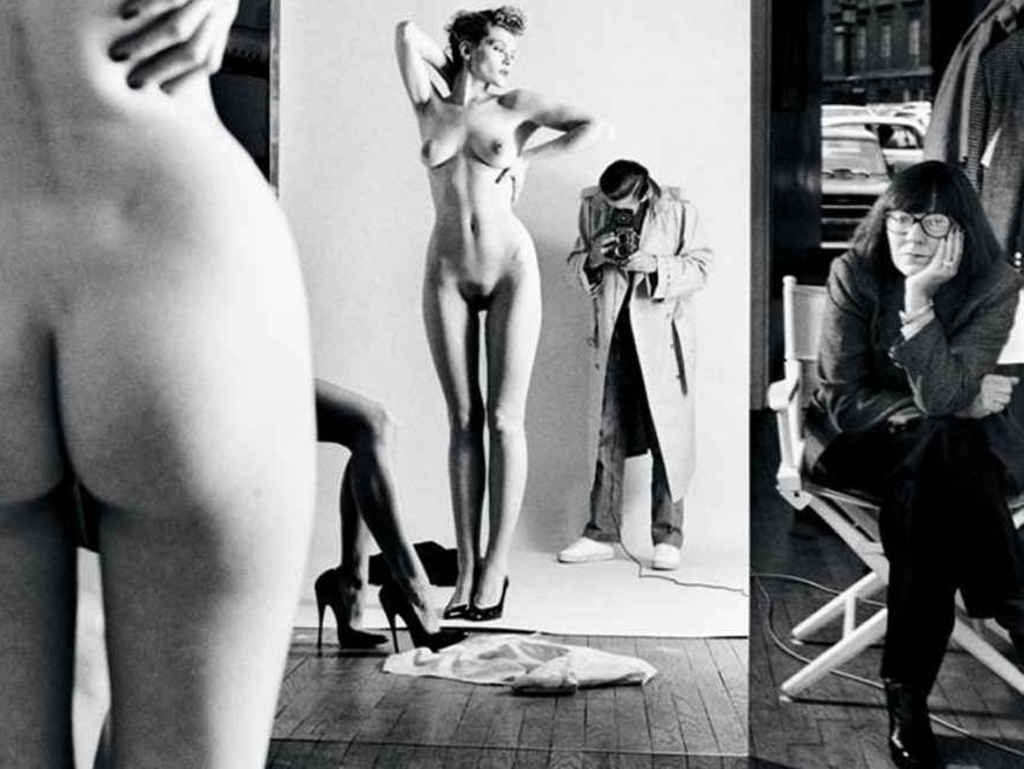
Just as Rembrandt maintained a dialogue with his audience by placing his self- portrait within many of his paintings, Newton’s appearance in his photography constantly reminds his viewers of the scenes’ counterfeit and the staged world of photography itself.  He repeatedly frames the images with “unintentional figures” other than the model, such as a stylist or lighting assistant.  He also includes the tools and backdrop of the set and his own image shooting the model, oftentimes in mirrored form. He does this repeatedly as if to remind the viewer that, “This is just a photograph. She is just a model. But this is my photograph, and she is arranged that way because I made it so.” One may see this playful detachment yet passionate interest featured from the outset of the exhibit. In the introductory room we see a photograph in which Newton stands in white, leaning against a studio spotlight. His posture is relaxed, almost tired, and his expression seems entirely disinterested. Yet, one can still glimpse a spark of curiosity behind his eyes and feel the very creative wheels that produced so many iconic images slowly, steadily churning.
  In a city rich with a lively, but burlesque perceptions of female sexuality and beauty, Foam Museum’s exhibition of Helmut Newton serves as a panacea. His life’s work offers a new perspective on the identity and sexuality of women, revealing the glamorous and powerful feminine warrior to compete with the pretty yet lifeless doll of editorial fashion photography of an earlier era. This exhibit successfully traverses Newton’s lifetime of work, providing the viewer with a rare overview of the evolution and growth of an extraordinary artist and his tireless creativity.